

Latin Name: Nephrolepis exaltata bostoniensis
Boston ferns are among the easiest of all ferns to grow. They grow best in a north-facing window in a cool room.
Needs:
Other cultivars:
Compacta -- 18" fronds
Fluffy Ruffles -- double-edged 12“ fronds
Verona-- lacy with triple, filmy 12" fronds
Dallas -- a miniature
Latin Name:
Davallia fejeesis — Rabbit's Foot Fern
Davallia trichomanoides — Squirrel's Foot Fern
This fern puts out unusual rhizomes that crawl along the top of the soil and even outside the plant's container. Because the rhizomes have a furry texture, Davallia ls commonly called Rabbit's Foot or Squirrel's Foot Fern. It is best grown in hanging baskets.
Needs:
Latin Name:
Asparagus densiflorus ‘Sprengeri’--Asparagus Fern
Asparagus densiflorus ‘Myen'-- Foxtail Fern
Asparagus steaceus liliaceae — Plumosa Fern
Asparagus ferns are not true ferns because they reproduce from seed, not spores. They really are related to the vegetable asparagus though!
Needs:
The Asplenium group of ferns offers considerable diversity.
Asplenium bulbiferum - Commonly called Mother Fern or Hen and Chickens Fern. This has graceful, finely cut fronds, sometimes reaching four feet in length. Unlike most ferns, it produces plantlets along its fronds that can be removed and planted — hence the plant's common name.
Asplenium nidus-Commonly called Bird's Nest Fern. This variety produces showy fronds to four feet long and 8" wide, growing upright in a cluster, completely undivided or cut.
Needs:
Latin Name: Platycerium bifurcatum
Staghorn or Elkhorn Fern is an epiphyte: it attaches to the side of a tree, sustaining itself on leaf mold and moisture that gathers around its roots. Gardeners grow Staghorn Fern on a slab of bark, on the stem of a tree fern, or occasionally in a hanging basket or on a tree.
Needs:
Latin Name: Pteris cretica, Pteris cretica ’AIbolineata‘ --white bands, also called Ribbon Fern
The Pteris ferns are mostly small ferns of subtropical or tropical origin, best suited to dish gardens or small pots
Needs:
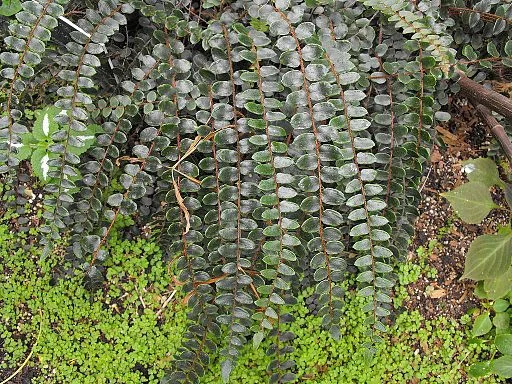
Latin Name: Pellaea rotundifolia
In nature, Pellaeas, or cliff-brake ferns, mostly grow on rocks. Of the few species grown indoors, by far the most popular is P. rotundifolia, the Button Fern. Propagate by division.
Needs:
Latin Name:
Adiantum capillus-veneris--Venus Maidenhair
Adiantum raddianum--Delta Maidenhair
The Adiantum, or Maidenhair Fern, is among the most delicate and beautiful of all ferns. Most are native to the tropics, although a few are native to the United States. Extremely thin and wiry, the stems are usually dark brown or black. Foliage is very thin textured and delicate; fronds are finely cut and most leaflets are fan shaped.
Needs:
Latin Name:
Polypodium aureum--Hare's Foot
Polypodium aureum Mandanianum--Lettuce Fern
Polypodium subauriculatum 'Knightiae’—Knight’s Fern
The Polypodium ferns include Hare's Foot Fern, a large fern with flat fronds 3 to 5 feet long. Another version, sometimes called Lettuce Fern, has fronds with frilled and wavy edges. Knight's Fern, also with frilled edges, looks something like a glorified Boston fern. All make good hanging basket displays.
Needs:
Latin Name: Selaginella wiIdenovii--Peacock Fern
Selaginella uncinata-- Rainbow Fern
Selaginella kraussiana--Krause's clubmoss
The Selaginella "Ferns", sometime called spikemoss or clubmoss, are moss-like plants that reproduce from spores, not seeds.
Needs:
There are also a number of ferns that are perennial in our area and are suitable for outdoor landscaping and container use. Holly fern, Christmas fern, and autumn fern are evergreen in our area, making them useful In the winter landscape or winter containers.
Image Credits:Boston fern By Mokkie (Own work) [CC BY-SA 3.0 (http://creativecommons.org/licenses/by-sa/3.0)], via Wikimedia CommonsRabbit's foot fern by Forest & Kim Starr [CC BY 3.0 (http://creativecommons.org/licenses/by/3.0)], via Wikimedia CommonsAsparagus fern by Yinan Chen (www.goodfreephotos.com (gallery, image)) [Public Domain], via Wikimedia Commons Mother fern By brewbooks [CC BY-SA 2.0 (http://creativecommons.org/licenses/by-sa/2.0)], via Wikimedia CommonsBird's nest fern by Daderot (Own work) [Public domain], via Wikimedia CommonsStaghorn fern by Tequila CC-BY-SA-3.0 (http://creativecommons.org/licenses/by-sa/3.0/), via Wikimedia CommonsBrake fern by Jerzy Opioła (Own work) [CC BY-SA 4.0-3.0-2.5-2.0-1.0 (http://creativecommons.org/licenses/by-sa/4.0-3.0-2.5-2.0-1.0)], via Wikimedia CommonsButton fern by Stickpen (Own work) [Public domain], via Wikimedia CommonsMaidenhair fern by Tigerente (Own work) [CC BY-SA 3.0 (http://creativecommons.org/licenses/by-sa/3.0)], via Wikimedia CommonsHare's foot fern by and (c)2006 Derek Ramsey (Ram-Man). Location credit to the Chanticleer Garden. (Own work) [CC-BY-SA-3.0 (http://creativecommons.org/licenses/by-sa/3.0/)], via Wikimedia CommonsKrause's clubmoss by Jerzy Opioła ({Own}) [CC BY-SA 4.0-3.0-2.5-2.0-1.0 (http://creativecommons.org/licenses/by-sa/4.0-3.0-2.5-2.0-1.0)], via Wikimedia Commons
Have a question or want to discuss your property? Fill out the form below, and we’ll get back to you as soon as we can!

.jpg)


